

 Smriti Gupta
 26 Sep-2025
 Learning & Development
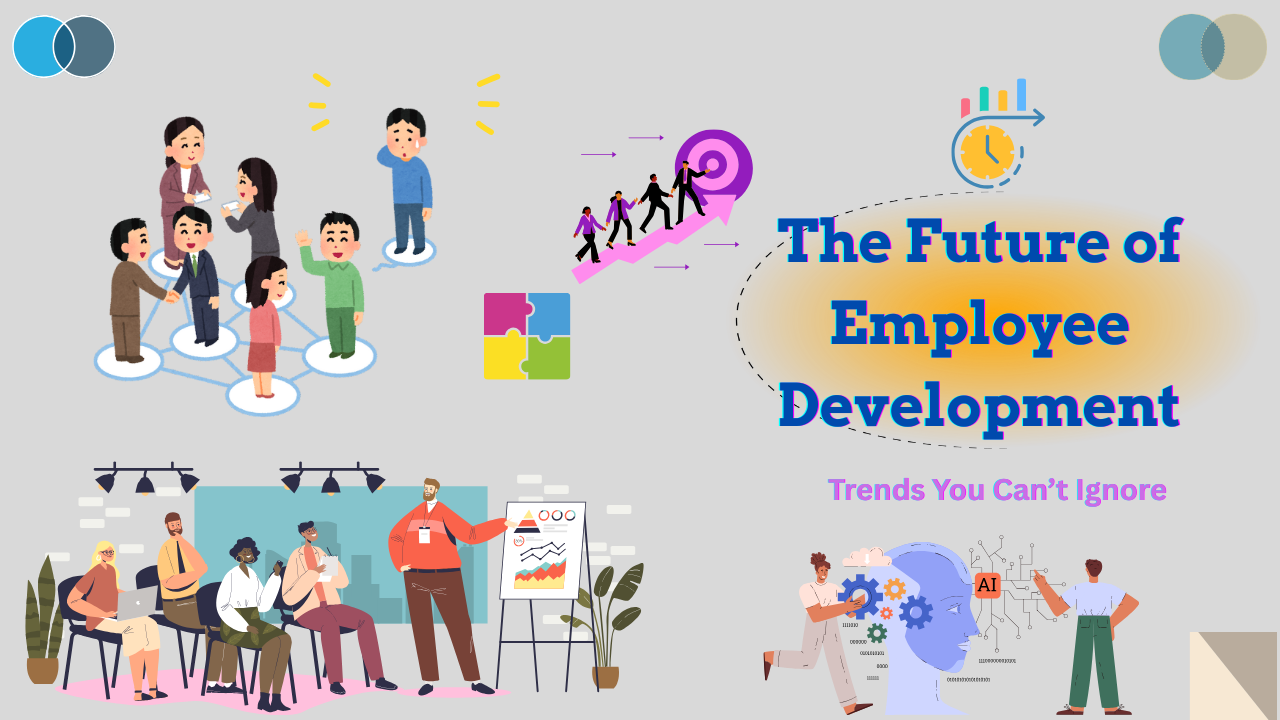
In the fast-paced world of nowadays, companies have begun to understand that their employees are their biggest asset, not only their technology, money, or strategy. Employee development, learning, and adaptation have emerged as a critical determinant for business achievement. Workforce skills must change along with industries. This is where employee development comes in. It is an ongoing, forward-looking process rather than a one-time training program. Employee development trends are evolving rapidly as more businesses utilize digital tools and individualized instruction.
This blog will discuss the importance of employee development trends, the leading trends in employee development that are influencing workplace learning techniques, and how businesses may get ready for the future of corporate training by implementing upskilling and reskilling programs.
The workplace of today has transformed dramatically. Job descriptions are being updated swiftly by technology, artificial intelligence, and digital transformation. Business strategy currently heavily relies on positions that weren't there ten years ago, such as data scientist, UX designer, and AI ethicist. New skill sets are required as old professions are being transformed.
Organizations suffer from skill shortages, decreased productivity, and disengaged employees in the absence of systematic employee development. More than 80% of CEOs believe that reskilling and upskilling are essential to the future of their organizations, according to international HR studies. Career development is one of the main drivers of talent retention, and employees expect their employers to support their professional development.
Businesses that don't put learning first run the risk of losing top people, falling behind rivals, and finding it difficult to adjust to shifting market conditions. In the end, investing in people is an investment in the long-term success and resilience of the company.
To put it briefly, staff development is now a strategic requirement rather than a "nice-to-have" perk.
Employee development has a dynamic and multifaceted future. Innovative workplace learning techniques are assisting businesses in creating a culture of constant improvement and flexibility. The following trends are coming together to influence how businesses create workplace learning strategies:
These trends in staff development demonstrate a noticeable change: learning is increasingly ingrained in everyday processes rather than being restricted to a classroom or an annual training schedule. Creating memorable learning experiences by combining technology and human-centered techniques is the way of the future for corporate training.
In previous days, training programs used to be overall. No matter their position or level of expertise, everyone goes through similar training programs. Time was wasted, and individual requirements were frequently not met. Corporate training is changing today due to individualized learning.
Real-time content adjustments are made via adaptive learning platforms using algorithms. The system offers additional resources if an employee is having trouble with a particular area of study. They progress to more advanced modules more quickly if they perform well.
Organizations can customize learning paths to meet the needs of each individual by using skill evaluations.
Busy professionals can fit learning into their schedules by using microlearning, which consists of little lessons that can be completed in a matter of minutes.
For instance, a software developer can be directed toward new programming languages, while a sales professional might receive AI-recommended modules on negotiating strategies. Employee engagement is maintained, and skill acquisition is accelerated by this customisation.
The core of corporate training's future is technology. Let's explore the game-changing elements:
Learning used to be frequently associated with getting a degree. Due to the rapid pace at which things are changing today, lifelong learning is crucial. Employees who work for companies that promote a culture of continual development are flexible, resilient, and prepared for the future.
Educating employees with new skills to perform their current jobs more effectively is known as upskilling. An illustration would be a marketing expert studying advanced data analytics.
Training employees to do a completely new role is known as reskilling. An illustration would be a customer service representative moving into the role of digital product manager.
For this to succeed, organizations ought to:
Organizations such as Google and Amazon have already implemented internal mobility initiatives and continuous learning, enabling staff members to advance with the company.
Proactive action is necessary for employee growth in the future. Here's how businesses can get ready:
In the end, companies that view staff development as an investment rather than an expense will win the future. The company expands along with its workforce.
The goal of employee development in the future is to establish a work environment where learning is ongoing, individualized, and intricately woven into daily tasks rather than simply fulfilling training requirements. Personalization, AI-powered platforms, virtual reality training, and an emphasis on reskilling and upskilling are some of the trends altering workplace learning techniques and how businesses and individuals prosper.
In addition to filling skill gaps, companies that adopt these trends in employee development will foster an innovative, flexible, and growing culture. Employee development serves as an organization's compass in a world where change is the only constant.